

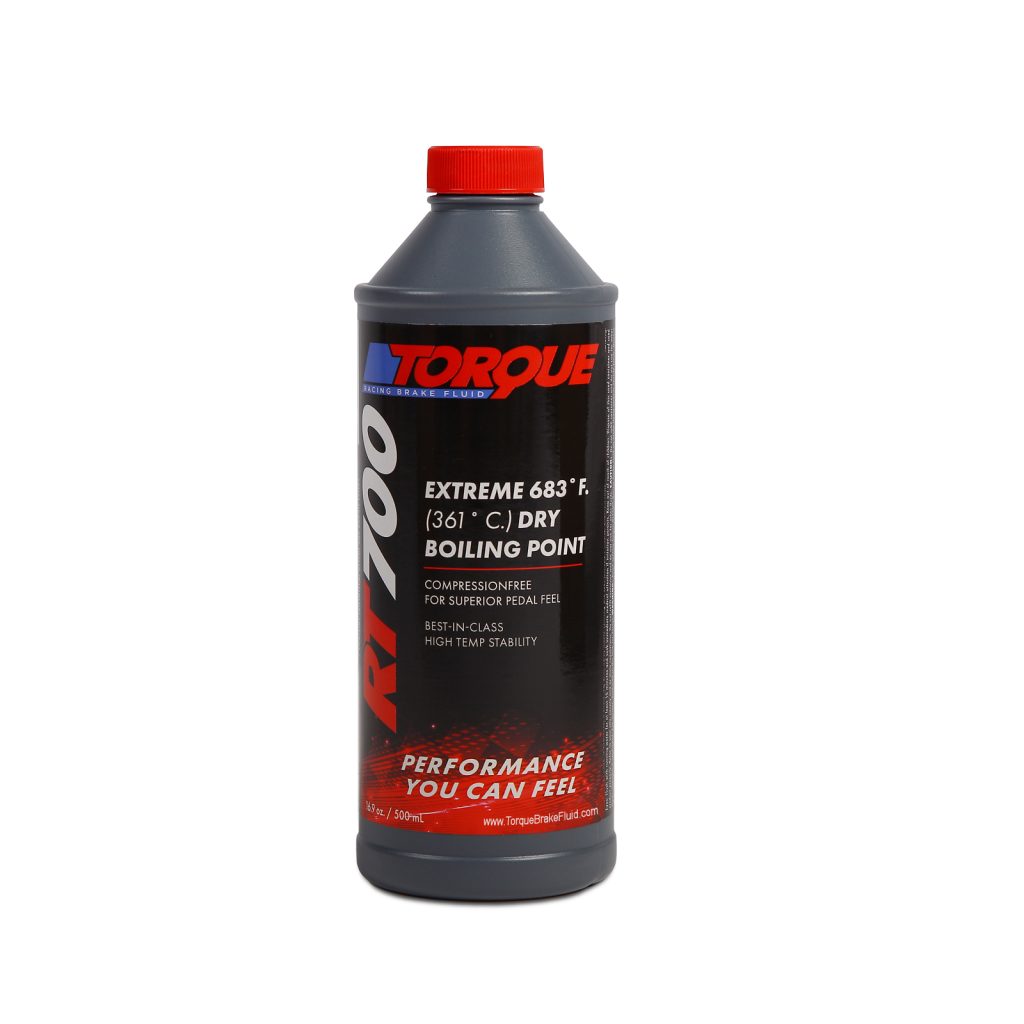
Description
| Comparisons
Table |
Dot 4 min standard | Torque RT700™ | Castrol SRF | Endless RF-650 | Motul RBF600* | Motul RBF660* | |
| Dry Boiling Point (°C)(as per mfr’s specs) | 230 °C | 361.7 °C | 310 °C | 322,7 °C | 312,2 °C | 325 °C | |
| Dry Boiling Point (°C)
(as per lab testing) |
– | 362,8 °C |
324,4 °C |
324,4°C |
298,8 °C |
308,8C |
|
| Wet Boiling Point (°C) (as per mfr’s specs) |
155 °C
|
225,6 °C |
269,4 °C |
217,7 °C |
215,5 °C |
204,4 °C |
|
| Wet Boiling Point (°C) (as per lab testing) |
– |
225,6 °C |
280 °C |
211,1 °C |
203,3 °C |
204,4 °C |
|
| High Temperature Stability (Boiling Point Change) |
±5.4 + 1 ° that original BP exceeds 225 °C |
-17.2 °C |
-15,83 °C |
-15,8 °C, |
-13,77 °C |
-15,8 °C |
|
| Chemical Stability (Boiling Point Change) |
±5.4 + 1 ° that original BP exceeds 225 °C | -17,09 °C | -15,77°C | -16,1 °C | -16,6 °C | -16,1°C | |
| Vapor Pressure | – | <0.01 mmHg @ 20 °C | N/A | N/A | N/A
|
N/A | |
| Density (Specific Gravity) | – | 1.095 | N/A | N/A
|
– | N/A | |
| pH
(7 = Neutral) |
7.0 – 11.5 | 7.3 | 9.1 | 5.7 | 7.1 | 6.8 | |
| Viscosity -4,44 °C (cSt) | 1800 max | 1501 | 1202 | 2543 | 1660 | 1434 | |
| Viscosity 100 °C (cSt) | 1.5 min | 2.1
|
3.5 | 3.5 | 2.7 | 2.7 | |
| Compressibility | No standard | 5.19E-05 @ 100 °C
@ 400 bar |
6.487E-05 @ 100 °C @ 400 bar | 5.868E-05 @ 100 °C @ 400 bar | N/A | N/A | |
| (Numerically lower numbers denote lessor compressibility) | – | 3.969E-05 @ 100 °C @ 400 bar | 5.230E-05 @ 100 °C @ 400 bar | 4.884E-05 @ 100 °C @ 400 bar | N/A | N/A | |
| – | 3.405E-05 @ 20 °C @ 400 bar | 4.621E-05 @ 20 °C @ 400 bar | 4.846E-05 @ 20 °C @ 400 bar | N/A | N/A | ||
| RESERVE ALKALINITY | No standard | 84 | 10 | 5 | 33 | 36 | |
| % H2O Content at Testing | No standard | 0.01 | 0.01 | 0.15 | 0.19 |
|
* Dry Boiling Point: For all DOT-compliant fluids, this is the temperature at which the fluid begins to boil when tested in the manner specifically described by the DOT. This basically means the fluid is tested brand-new, right out of a freshly opened bottle, before being contaminated by moisture and other fluids.
* Wet Boiling Point: This is a similar test to the Dry Boiling Point, but this time performed on the fluid after it has had time to absorb moisture from its surroundings.
* High Temperature Stability:
This is a measure of how stable the dry ERBP temperature is as fluid temperature increases, applying universally to all grades of brake fluids. The High Temperature Stability of Torque Race Brake Fluid RT700 is just 2°F (1°C).
* Viscosity: This is where the DOT 3 spec could be interpreted as actually being better for the miniature passages of an ABS system than the DOT 4 spec. Thinking about motor oil, the higher the viscosity number, the slower the flow of the (thicker) oil. The same basic principle applies to brake fluid, although the measurement technique is different. The DOT 3 specification for viscosity at -40°F is 1500 mm2/s, where DOT 4 is 1800 mm2/s. So, the DOT 3 fluid flows better at the cold testing temperature than the DOT 4. To confuse the issue even further, DOT 5.1 fluids were developed specifically to better meet the lower viscosity requirements of the more complex ABS and DSC systems, while also meeting the higher boiling point specifications of DOT 5 silicone-based fluids. It should also be noted the viscosity specification at 212°F / 100°C for all DOT variants is 1.5 mm2/s. While it may be better for those who race snow machines above the Arctic Circle to choose a brake fluid with a lower viscosity, fluids with a higher viscosity number at the lower test temperatures usually provide a better and more consistent braking feel, as Torque has found through extensive track-testing with professional racing drivers.
* Compressibility: This is not a specific DOT call-out, yet it is critically important to racers and enthusiasts. SAE J1705, Appendix A, A.2.2.8, states “Air Solubility – It has been reported that dimethyl polysiloxane fluid, which is a major part of silicone-based, low water-tolerant type brake fluids can typically contain dissolved air at a level of 16% ±3% by volume at standard temperature and pressure. This compares with a typical level of 5% ±2% by volume of dissolved air for glycol ether based type fluids. An increase in brake pedal travel may be experienced under severe operating conditions, especially at higher altitudes and high temperature conditions. “The term “dissolved air” (air absorbed from the atmosphere) should not be confused with the term “entrapped” or “free air” since their effects on brake system performance can be entirely different. Air that has been absorbed from the atmosphere does not result in an increase in fluid or system volume, whereas entrapped air or free air does occupy system volume and can be easily compressed when force is applied to the system.“ The SAE standard continues, “A.2.2.8 – Compressibility – Silicone based brake fluids are more compressible than conventional brake fluids and the difference is magnified at higher temperatures.” Silicon-based brake fluids are described by DOT 5 (not to be confused with DOT 5.1), which should never be used in a racing vehicle due primarily to its compressibility. Compressibility is largely ignored by those selling nearly all the brake fluids on the market — and with good reason! It is better you aren’t told that their fluid could contain as much as 7% dissolved air!! Once they are tested specifically for compressibility, it is no surprise that certain “high end” racing fluids are known in the paddock for their poor pedal feel. A research report published by Union Carbide demonstrates a relationship between the compressibility of a brake fluid and its density (or specific gravity). The greater the density of a brake fluid the less compressible it is. As there is no DOT specification, within the scope of the Polyalkylene Glycol Ether-based fluids there can be a density difference range of over 200% between fluids! Since brake feel is so important to driver confidence and, ultimately, lap times, Torque RT700 Racing Brake Fluid has been successfully formulated to be the highest ever density brake fluid availeble on the market.
*PH: This is an indicator of the fluid’s corrosion resistance and high temperature stability. A higher pH will prevent corrosion for a longer time.
*Reserve Alkalinity: This strange term describes how a brake fluid keeps expensive brake system components protected from corrosion over time. Fluids with a higher reserve alkalinity can stay in service longer, while those with lower numbers need to be changed more frequently or risk potential corrosion of master cylinders, calipers, ABS valve bodies, steel brake tubing and other components as the fluid becomes progressively more acidic. Typical DOT 3 and DOT 4 fluids drop to 20% of their original value in 18 to 20 months of street use. Yet this drop in pH can occur much sooner when exposed to thermal oxidation and volatilization – otherwise known as racing, track days, spirited hills runs, etc. This is another reason why even today’s better brake fluids must be changed after seeing elevated temperatures. If you have ever been told to also flush your brake fluid after a track day, this is why.
Torque RT700 Racing Brake Fluid has the highest reserve alkalinity available – and by a large margin. It can be used longer, saving both money and time flushing brake fluid.


Reviews
There are no reviews yet.